AI tools have become incredibly smart. But the real world still runs on phone calls. That’s the gap CALL-E was built to solve.

Real Life Still Depends On Someone Making The Call
You’ve probably had one of those days where everything feels small but exhausting at the same time.
Your calendar is packed, your notifications won’t stop, and in between all of that, you suddenly remember you still need to call the clinic to move your appointment, check whether the pharmacy has your prescription ready, confirm a reservation, or follow up on a delayed delivery. None of these tasks are difficult on their own, but together they quietly consume a surprising amount of time and mental energy every week.
That’s the strange reality of modern life right now. AI tools can help people brainstorm ideas, write documents, summarize meetings, organize projects, and automate digital workflows. But once something requires talking to the real world through a phone call, most people are still stuck doing everything manually themselves.
And the truth is…the real world still runs heavily on phone calls. Businesses still rely on calls for confirmations and coordination. Public offices still ask people to “call directly.” Clinics still handle scheduling changes over the phone. Local stores still answer inventory questions manually. Even simple plans between friends and family often turn into unnecessary rounds of calling and texting just to confirm details.
The internet has become faster and smarter. Everyday coordination didn’t.
Traditional Phone Automation Was Built For Repetition, Not Real Life
For years, automated calling systems only worked inside highly repetitive environments. Traditional voice platforms were built around reusable workflows, which meant companies had to spend huge amounts of time upfront designing scripts, conversation trees, escalation paths, and response logic before a single automated call could even happen.
That model worked extremely well for repetitive use cases like appointment reminders, customer surveys, collections, and support hotlines because the same conversation happened over and over again on a large scale.
But real life doesn’t work like that.
Most real-world phone calls are contextual, unpredictable, and low-frequency. A customer calling to ask if a product is still available before driving across town. Someone confirming whether a restaurant can accommodate a last-minute change. A parent called a school office for clarification. A small business owner following up on delayed inventory from a supplier. A quick call between friends trying to coordinate arrival times.
These conversations are easy for humans because humans naturally adapt during conversations. But historically, they were too dynamic and too infrequent for traditional automation systems to handle economically. So, humans continued doing them manually.
CALL-E Treats Phone Calls As Real-Time Tasks
CALL-E introduces the Calling Subagent: a real-time phone execution layer that gives AI tools the ability to make calls dynamically based on the task itself. Instead of relying on rigid reusable workflows, CALL-E generates the conversation naturally in real time, adapts during the interaction, and completes the objective without requiring prebuilt scripts underneath.
One task. One call.
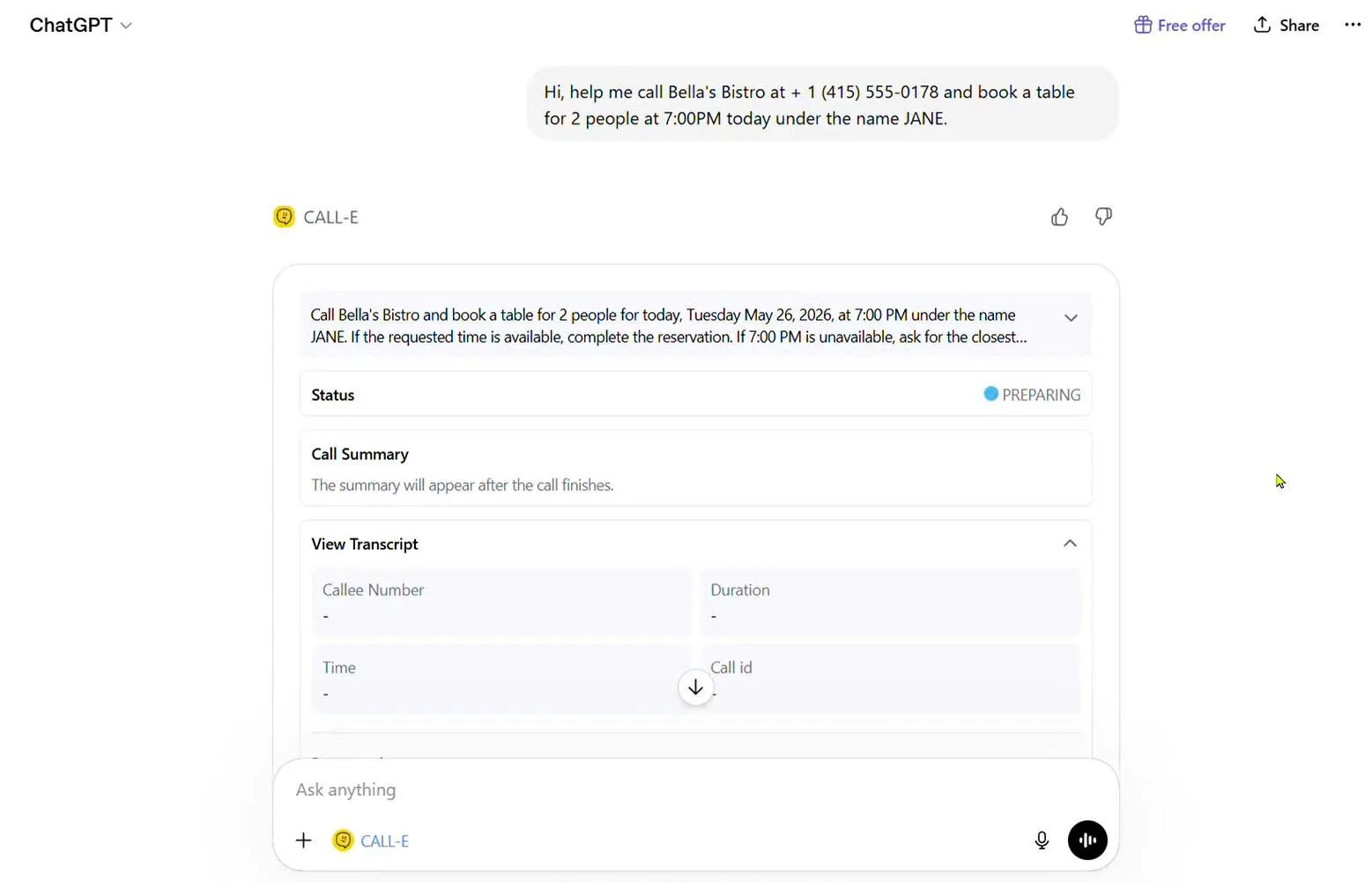
That may sound like a small shift, but it fundamentally changes the economics of phone automation. For the first time, low-frequency and personalized calls suddenly become practical to automate because the workflow no longer needs to exist before the conversation begins.
The intelligence happens during execution itself. That means conversations can adapt naturally depending on the context, the responses, and the situation unfolding during the call.
And honestly, that’s what makes CALL-E feel less like a traditional phone system and more like a missing layer between AI tools and the real world.
The Most Common CALL-E Use Cases Are Surprisingly Human
One of the most interesting things about CALL-E is that the strongest use cases right now are not giant enterprise automation projects. They’re ordinary everyday moments people deal with constantly.
- Calling businesses to check pricing, stock, or opening hours
- Confirming reservations, schedules, and appointments
- Coordinating plans with personal contacts and family members
- Contacting public institutions to clarify procedures or eligibility
- Relaying messages or following up on lightweight operational tasks
- Managing small coordination tasks during busy workdays
Some users simply want to avoid waiting on hold. Others use CALL-E while multitasking during work hours. Some people dislike making phone calls entirely. Others just want to reclaim small pockets of time throughout the day.
And that’s what makes this shift important. CALL-E is not solving some abstract futuristic problem. It’s solving tiny moments of friction people repeatedly encounter every single day.
KEY TAKEAWAY: AI Helped Us Work Faster. CALL-E Helps Us Move Through Life Faster.
Modern life contains an enormous amount of invisible coordination work. Tiny confirmations, scheduling changes, follow-ups, and operational tasks that seem insignificant individually but quietly drain time, attention, and energy every week.
CALL-E exists to handle exactly those moments. Not to replace human relationships. Not to remove human communication entirely. But to take over the coordination layer, people never actually wanted to spend their time on in the first place.
For support tickets, contact support@heycall-e.com
Want to explore what CALL-E can do or share feedback with the community?
Join our Discord: https://discord.gg/SDcGdhgRzj